


By DR Tech | Cost, thermal comfort, strength and availability across Kerala districts
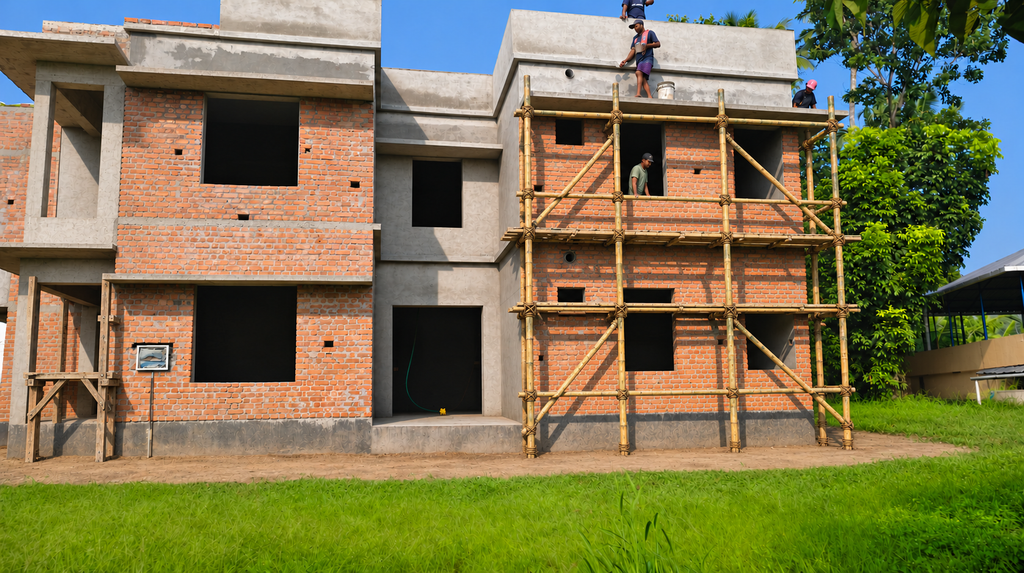
Every Kerala homeowner reaches the same crossroads before the foundation is even dug: what should my walls be made of? Ask five neighbours and you will get five confident answers. The traditional favourite is the laterite house of Kerala, built from the red chenkallu that has shaped our architecture for centuries. Others swear by burnt clay bricks, and a growing number choose hollow concrete blocks for speed and economy.
The honest answer is that no single material wins everywhere. The right choice depends on your district, plot, budget and design. At DR Tech, we are often asked to settle the debate on site, so here is the practical comparison we share with our clients, covering cost, thermal comfort, strength and availability.
A note on numbers: Prices and strength figures below are indicative ranges. Material rates change with season, quarry supply and transport distance, so always get a current quotation before you finalise a budget.
1. Laterite Stone (Chenkallu)
Laterite is a clay-rich rock found across the Kerala midland and coastal belt. It is cut from the quarry while soft and hardens on exposure to air, which is why freshly cut blocks are easy to shape but weather into a tough, durable wall.
Strengths
- Excellent thermal comfort. Laterite is porous and has good insulating behaviour, so walls absorb less heat and release it slowly. In our hot, humid climate, laterite interiors often feel noticeably cooler.
- Climate-suited. It has performed in monsoon-heavy Kerala for centuries, and old laterite structures across Malabar are proof.
- Natural look. The warm red-brown texture suits exposed-stone elevations and needs little decoration.
- Local and low-carbon when sourced near the site.
Limitations
- Costly outside quarry districts. Transport can push the price up sharply in the south.
- Variable quality. Blocks differ by quarry, so selection matters.
- Slower masonry. Blocks are heavier and less uniform, which means more labour and more mortar.
- Needs proper waterproofing and a good plinth to manage dampness during heavy rain.
Indicative cost: a dressed block typically costs several times as much as a burnt brick, though the block is larger. Overall wall cost per square foot is usually the highest of the three options in non-laterite districts and competitive in the north.
2. Burnt Clay Brick
Brick is the most familiar material in Kerala construction. Fired clay bricks, whether from local kilns or brought in from neighbouring states, are uniform, easy to lay and widely understood by masons.
Strengths
- Reliable and predictable. Standard size, consistent quality from good kilns, and a well-known construction method.
- Good strength for load-bearing walls in typical one- and two-storey homes.
- Moderate thermal performance. Better than solid concrete, though not as cool as laterite.
- Easy to plaster and finish, with a good bond to cement mortar.
Limitations
- Supply and price swings. Clay extraction rules and seasonal kiln closures can cause shortages and rate increases.
- Water absorption. Low-quality bricks soak up moisture and show efflorescence (white salt patches) if not protected.
- More mortar and plaster than larger blocks, which adds to labour and time.
Indicative cost: each brick is cheap, but you need many more of them, so the saving over other materials is smaller than it first appears.
3. Hollow Concrete Block
Hollow blocks are the speed-and-economy choice. They are large, machine-made and uniform, which is why they dominate apartments and fast-track residential projects, especially around Kochi.
Strengths
- Fast construction. Large units mean fewer joints, quicker laying and less mortar.
- Lower overall wall cost in many urban areas, with the saving coming from reduced labour and plaster.
- Consistent size and strength when produced by a reputable plant, with good dimensional accuracy for neat plastering.
- Lighter dead load than solid walls, which can reduce structural cost.
- Easy to run services through cavities when planned well.
Limitations
- Weaker thermal performance than laterite. The hollow core helps, but concrete still holds and transfers heat.
- Quality varies by manufacturer. Poorly cured, low-cement blocks crack and absorb water.
- Needs good detailing at sills, lintels and openings, plus proper waterproofing in coastal or high-rain locations.
Indicative cost: a block costs more than a brick but covers far more wall area, which is why finished cost per square foot often comes out lowest.
Side-by-Side Comparison
| Factor | Laterite Stone | Burnt Brick | Hollow Block |
| Upfront material cost | Highest outside quarry districts | Moderate | Lowest finished cost in most cities |
| Thermal comfort | Best | Good | Fair (improves with cavity and plaster) |
| Compressive strength | Good, varies by quarry | Good, depends on kiln grade | Good, depends on block grade and curing |
| Construction speed | Slowest | Moderate | Fastest |
| Moisture behaviour | Porous, needs a good plinth | Absorbs water if low grade | Needs waterproofing and good curing |
| Availability | Strongest in northern districts | Widespread | Widespread, strongest near cities |
| Look | Natural, exposed finish | Plastered or exposed | Plastered |
Availability Across Kerala Districts
Where you build changes the answer more than almost anything else.
- Northern Kerala (Kasaragod, Kannur, Kozhikode, Malappuram): Laterite country. Quarries are close, masons are experienced with the material, and prices are the most favourable. A laterite house here is often the natural and economical choice.
- Central Kerala (Thrissur, Palakkad, Ernakulam): Laterite is available but costs more as distance from the quarries grows. Brick and hollow block are both strong options, and Kochi has an especially well-developed hollow block and ready-mix supply chain.
- Southern Kerala (Kollam, Thiruvananthapuram, Pathanamthitta, Alappuzha, Kottayam, Idukki): Laterite is available but typically transported, so it is more of a premium choice. Bricks and hollow blocks are the practical mainstays, and Thiruvananthapuram has dependable supplier networks for both.
For any district, remember that the nearest reliable source usually gives the best price and the lowest transport carbon footprint.
Brick vs Hollow Block in Kerala: Which Should You Pick?
For many families, the real contest is brick vs hollow block in Kerala, because laterite may be out of reach in their district. Here is a quick way to decide:
- Choose hollow block if speed and total cost are your priorities, you are building in or near a city, and you are willing to invest in good plastering, waterproofing and insulation details.
- Choose brick if you want a familiar, flexible material, you have access to a reliable kiln, and your design includes many curves, niches or custom details.
- Choose laterite if comfort and character matter most, your plot is in or near the northern belt, or you want an exposed-stone elevation that ages beautifully.
Hybrid walls work well too. Many homes use laterite for the front elevation and compound wall, with block or brick for internal partitions. That keeps the beauty and cooling benefit where it counts while controlling the budget.
Thermal Comfort: A Closer Look
Kerala’s heat and humidity make wall material more than a cosmetic decision. Laterite’s porosity helps keep interiors cooler during the day. Brick sits comfortably in the middle. Hollow block can be made much more comfortable by combining it with good roof insulation, cross-ventilation, deep overhangs, light-coloured exterior paint and well-shaded windows.
In practice, design matters as much as material. A well-planned hollow block house can feel better than a badly oriented laterite house. That is why the wall decision should always be made together with your architect and builder, not in isolation.
Strength and Durability
All three materials are suitable for typical residential construction when quality is controlled. What matters is:
- Grade and testing. Ask for compressive strength details for bricks and blocks, and inspect laterite for uniformity and soundness.
- Proper mortar mix and curing. Even the best material fails with poor workmanship.
- A strong RCC frame. In most modern Kerala homes, the structure carries the load and the walls act as infill, so wall material is not the only factor in structural safety.
- Moisture protection. Plinth protection, damp-proof course and good drainage extend the life of every wall type.
How DR Tech Helps You Choose
Picking the right wall material is only one part of building a home you will love for decades. If you are searching for the best construction company in Trivandrum or the best construction company in Kochi, look for a team that does not push a single product but compares options honestly for your plot, budget and climate.
At DR Tech, we help clients by:
- Assessing your site and district so the material you choose is both practical and cost-effective.
- Providing transparent estimates that compare laterite, brick and hollow block side by side.
- Sourcing from trusted suppliers and checking quality before material reaches your site.
- Planning for thermal comfort and waterproofing from day one, rather than as an afterthought.
- Delivering clear timelines and quality supervision from foundation to handover.
Whether you are building in the capital city or the commercial heart of Kerala, our goal is the same: a strong, comfortable, good-looking home that fits your budget.
Frequently Asked Questions
Is a laterite house good for Kerala? Yes. Laterite suits Kerala’s climate, offers good thermal comfort and has a long track record here. Its main drawback is higher cost and transport in districts far from the quarries.
Which is cheaper in Kerala, brick or hollow block? Hollow block usually works out cheaper per square foot of finished wall in most urban areas because it is faster to lay and needs less mortar and plaster. Local rates can change this, so compare current quotes.
Which material keeps the house coolest? Laterite generally gives the best thermal comfort, followed by brick, then hollow block. Roof insulation, ventilation and shading can narrow the gap significantly.
Can I mix materials in one house? Yes, and it is common. Many homeowners use laterite on exposed elevations and block or brick elsewhere to balance looks, comfort and cost.
Do I need an engineer to choose the wall material? It is strongly recommended. An experienced builder or engineer can match the material to your soil, structure, budget and design.
Final Thoughts
There is no universal winner. Laterite rewards you with comfort and character, brick gives dependable all-round performance, and hollow block delivers speed and savings. The smartest approach is to match the material to your district, your budget and your design, then back it with good workmanship.
Ready to plan your home? Talk to the DR Tech team for a site-specific comparison and a transparent estimate, and build with a company that puts quality and honest advice first.